
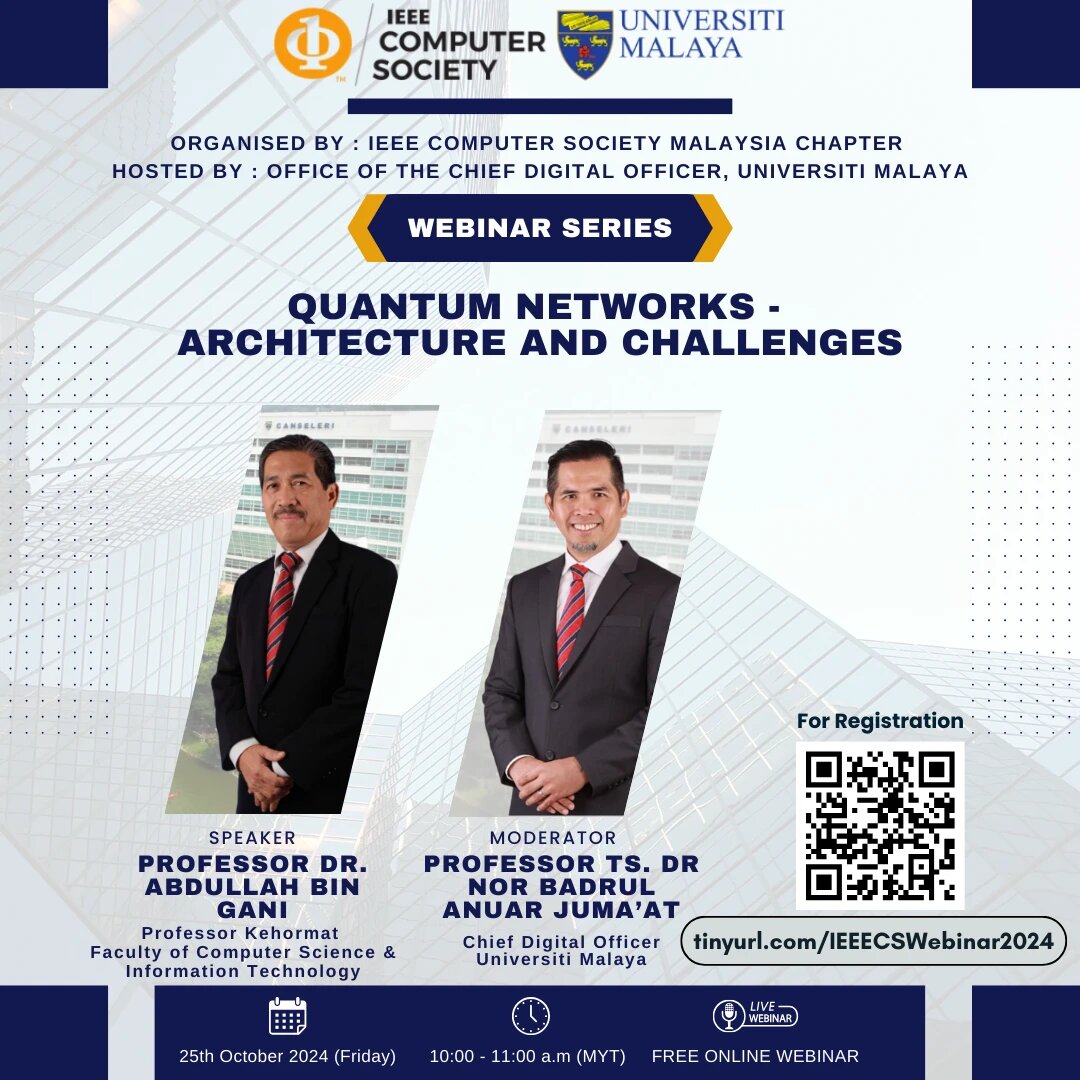
The IEEE Computer Society Malaysia Chapter, with the Office of the Chief Digital Officer, Universiti Malaya, held this session of the 2024 IEEE Computer Society Malaysia Chapter Webinar Series, "Embracing the Future: Cutting-Edge IT Trends and Innovations", attended by 24 participants.
Session Details
- Title: Quantum Networks: Architecture and Challenges
- Date: Friday, 25 October 2024
- Time: 10:00 a.m. - 11:00 a.m. (MYT)
- Format: Online webinar via Google Meet
Watch the Recording
The full session, including the Q&A, is available on YouTube: https://youtu.be/LL4X7DoxwUk
Synopsis
The architecture and challenges of quantum networks: the potential of quantum communication for secure data exchange, the technical complexities involved, opportunities for innovation and the future landscape of quantum networking.
Speaker
Prof Dr Abdullah Gani, Professor Kehormat, Faculty of Computer Science & Information Technology, Universiti Malaya
Moderator
Prof. Ts. Dr. Nor Badrul Anuar Bin Juma'at, Chief Digital Officer, Universiti Malaya, and Head of CSNET.
Highlights from the Session
- Prof Abdullah Gani approaches quantum networks from a computer networking view, built on four quantum phenomena: superposition, entanglement, measurement (decoherence) and the no-cloning theorem.
- A quantum network sends qubits from sender to receiver through a chain of quantum repeaters, using entanglement and teleportation over a quantum channel alongside a classical channel.
- Key open challenges include long-distance entanglement distribution, decoherence, quantum memory, scalability, detection efficiency, integration with classical networks and the lack of standards.
- A quantum computer is not required to build a quantum network, since the algorithms can run on existing classical machines while quantum repeaters carry the qubits.
- He expects quantum networks to reach the general public in about 10 years and urges researchers to start now, using simulators to study QKD, quantum internet and error correction.