
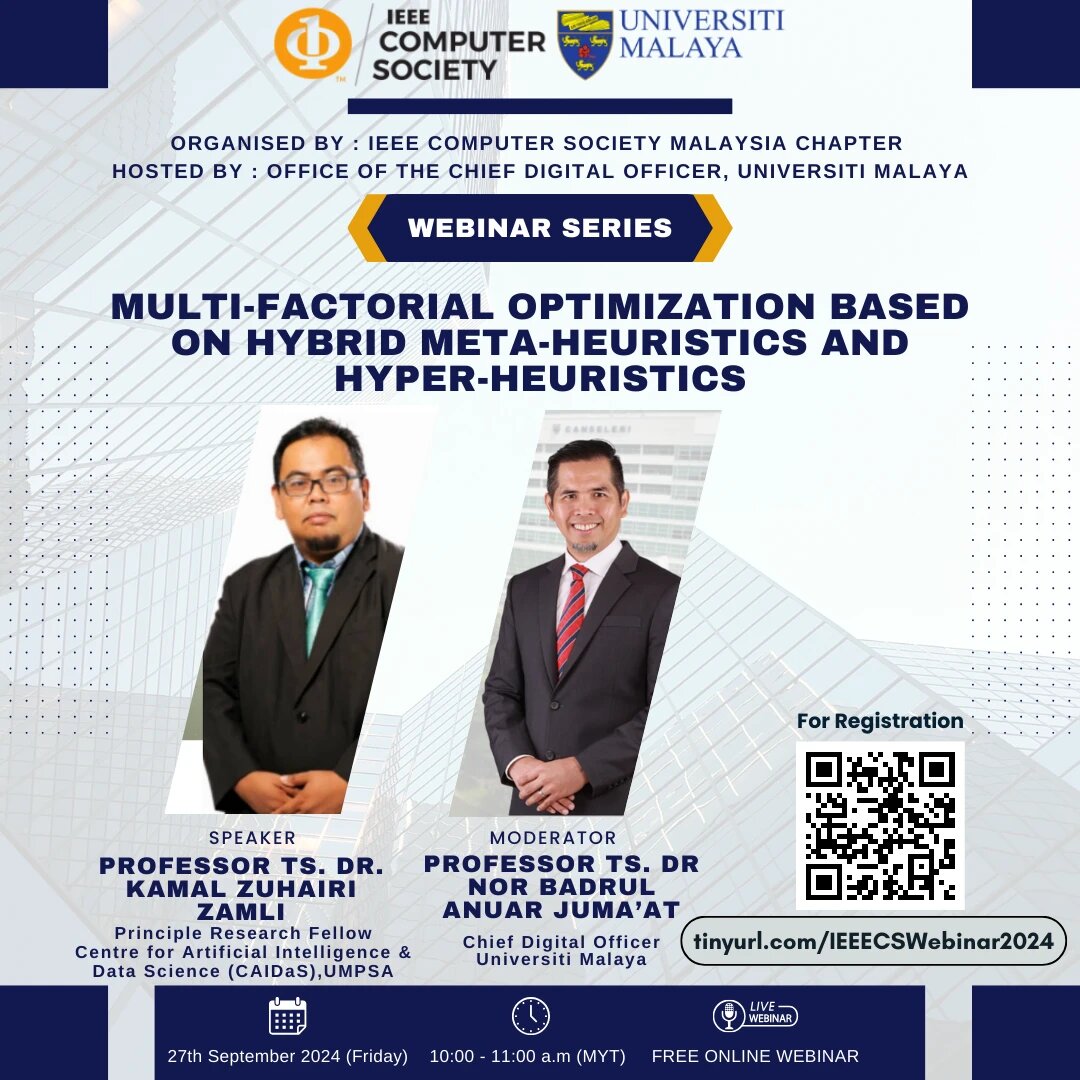
The IEEE Computer Society Malaysia Chapter, with the Office of the Chief Digital Officer, Universiti Malaya, held this session of the 2024 IEEE Computer Society Malaysia Chapter Webinar Series, "Embracing the Future: Cutting-Edge IT Trends and Innovations", attended by 22 participants.
Session Details
- Title: Multi-Factorial Optimization: Hybrid and Hyper-Heuristics
- Date: Friday, 27 September 2024
- Time: 10:00 a.m. - 11:00 a.m. (MYT)
- Format: Online webinar via Google Meet
Watch the Recording
The full session, including the Q&A, is available on YouTube: https://youtu.be/vbL2xdR_UY4
Synopsis
Advanced optimisation with hybrid meta-heuristics and hyper-heuristics, and how these approaches solve complex computational problems in logistics, artificial intelligence and engineering, with a focus on multi-factorial challenges.
Speaker
Prof Kamal Zuhairi Zamli, Universiti Malaysia Pahang Al-Sultan Abdullah
Moderator
Prof. Ts. Dr. Nor Badrul Anuar Bin Juma'at, Chief Digital Officer, Universiti Malaya, and Head of CSNET.
Highlights from the Session
- Test redundancy reduction is a set covering problem: finding the smallest subset of tests that still covers every requirement, which exhaustive search cannot handle for large test suites.
- Multifactorial optimization solves several independent tasks at once with a single shared population, running sequentially but achieving implicit parallelism, and it is not the same as multi-objective optimization.
- The Gupta and Ong inter-task learning algorithm accepts a shared update only if the scalar fitness, computed from each task's ranking, improves across the tasks.
- Tasks can be combined only if they share a unified solution representation, and minimization and maximization tasks cannot be mixed because the method relies on ranking.
- In the demo, solving an S-box design and a test reduction problem together gave essentially the same results as solving each one alone, with nonlinearity around 109.5 and a reduction to three tests.