
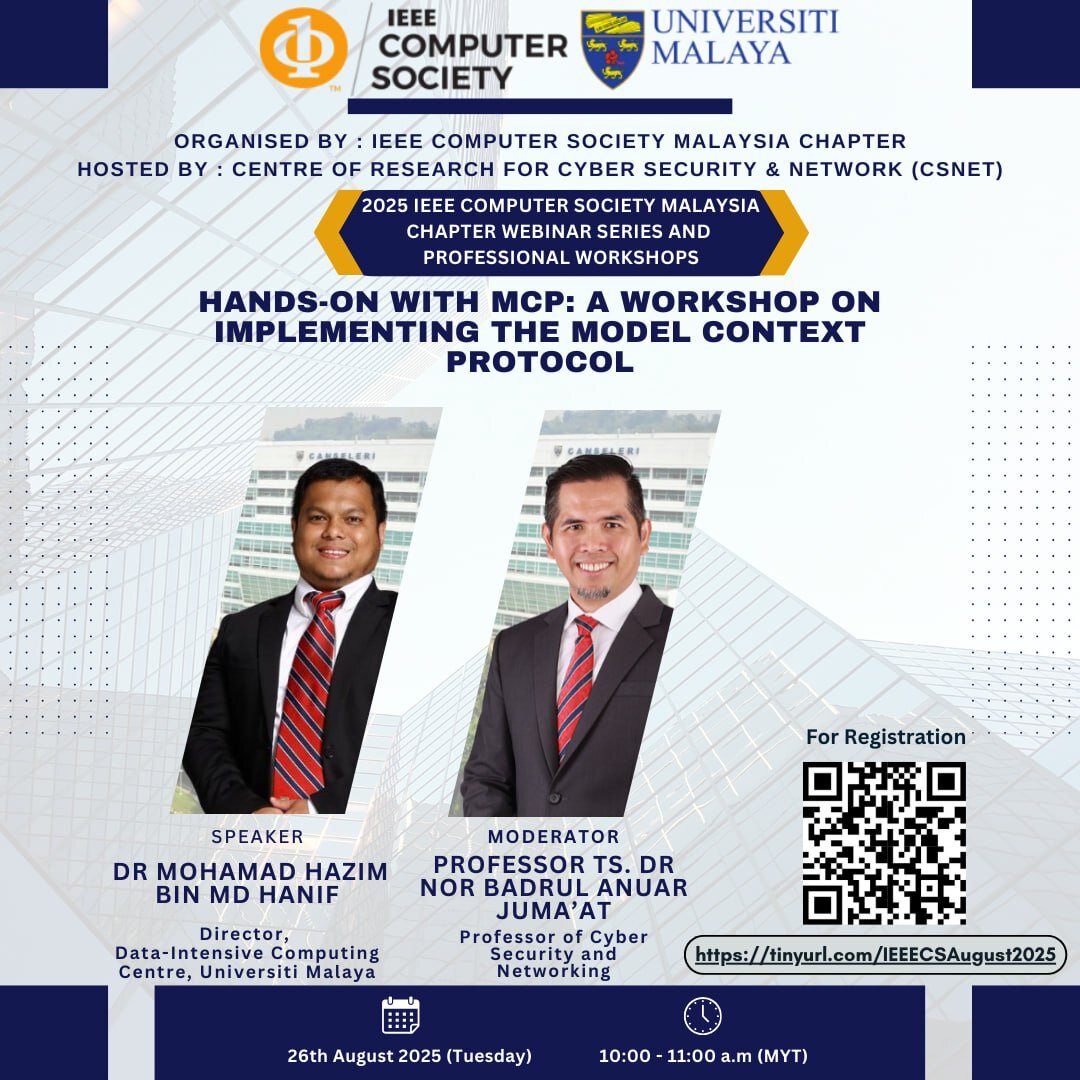
The IEEE Computer Society Malaysia Chapter, with the Centre of Research for Cyber Security & Network (CSNET), Universiti Malaya, held this session of the 2025 IEEE Computer Society Malaysia Chapter Webinar Series & Professional Workshops, attended by 46 participants.
Session Details
- Title: Hands-on with MCP: A Workshop on Implementing the Model Context Protocol
- Date: Tuesday, 26 August 2025
- Time: 10:00 a.m. - 11:00 a.m. (MYT)
- Format: Online webinar via Google Meet
Watch the Recording
The full session, including the Q&A, is available on YouTube: https://youtu.be/8RUGdoU7hlY
Synopsis
A practical workshop on the Model Context Protocol (MCP): why connecting AI models to external tools and data has been messy, how MCP standardises that communication, and a hands-on guide to getting more predictable, accurate and reliable results from your AI.
Speaker
Dr Mohamad Hazim Md Hanif, Director, Data-Intensive Computing Centre (DICC), Universiti Malaya, and CSNET researcher. PhD in Computer Security and AI (Imperial College London); works on LLMs for cybersecurity and software vulnerability detection.
Moderator
Prof. Ts. Dr. Nor Badrul Anuar Bin Juma'at, Director, Centre of Research for Cyber Security and Network, Universiti Malaya.
Highlights from the Session
- MCP, announced by Anthropic in November 2024, is an open standard that works like a USB-C port for AI, letting an LLM connect to sources such as GitHub, databases, Slack and Gmail.
- MCP follows a standard client-server design with a host application (VS Code, Cursor, Claude Desktop), one client per server, and servers that are essentially web services run locally or hosted remotely by a provider.
- In VS Code the MCP tools only act in Copilot's agent mode, and the demos used GitHub, Playwright and MySQL MCP servers to read and create repos, summarise a news page and query the Sakila database in natural language.
- RAG passively retrieves knowledge from documents while MCP adds actions and tool execution, so the two complement rather than replace each other.
- MCP servers can contain malicious code, keeping data private requires a locally hosted LLM with local MCP servers, and the LLM must support tool or function calling.