
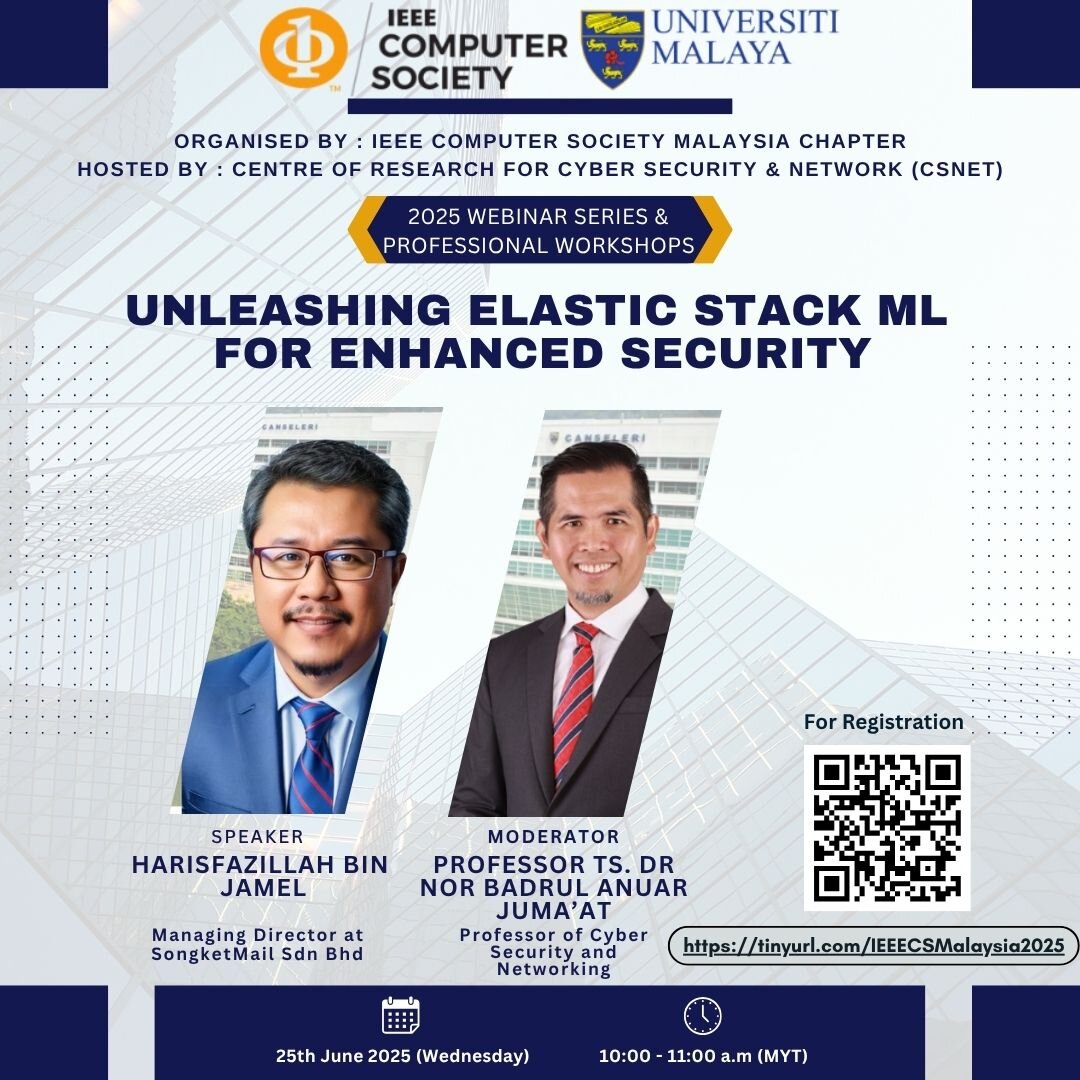
The IEEE Computer Society Malaysia Chapter, with the Centre of Research for Cyber Security & Network (CSNET), Universiti Malaya, held this session of the 2025 IEEE Computer Society Malaysia Chapter Webinar Series & Professional Workshops, attended by 25 participants.
Session Details
- Title: Unleashing Elastic Stack ML for Enhanced Security
- Date: Wednesday, 25 June 2025
- Time: 10:00 a.m. - 11:00 a.m. (MYT)
- Format: Online webinar via Google Meet
Watch the Recording
The full session, including the Q&A, is available on YouTube: https://youtu.be/jS5_Y7UJBhQ
Synopsis
A technical dive into the machine learning features of the Elastic Stack for cybersecurity: detecting anomalies, spotting threats in real time and automating security monitoring, for a more resilient and proactive defence. Includes live walk-throughs of Elastic Security rules and MITRE ATT&CK coverage.
Speaker
Harisfazillah Jamel, Managing Director, SongketMail Sdn Bhd. An ICT veteran of 25+ years, a leading figure in Malaysia's open-source community and a key organiser of the Malaysia Open Source Conference (MOSC).
Moderator
Prof. Ts. Dr. Nor Badrul Anuar Bin Juma'at, Director, Centre of Research for Cyber Security and Network, Universiti Malaya.
Highlights from the Session
- Elastic Security maps its detection rules to the MITRE ATT&CK framework, so teams can see where their detection coverage is strong and where gaps remain.
- A single Elastic Agent, managed centrally through Fleet in Kibana with separate agent policies and integrations per platform, replaces the older Beats for collecting logs, metrics and endpoint data.
- Elastic ships a growing, open-source library of prebuilt detection rules (about 1,453 at the time of the talk) that can be enabled directly, alongside custom rules for your own logs.
- Built-in machine learning jobs such as domain generation algorithm (DGA) detection and C2 beaconing detection help catch malware that keeps switching domains to reach its command-and-control server.
- For a small or medium enterprise, the speaker recommends starting with Elastic Security and Elastic Defend to protect endpoints, and exploring the features first on demo.elastic.co.