
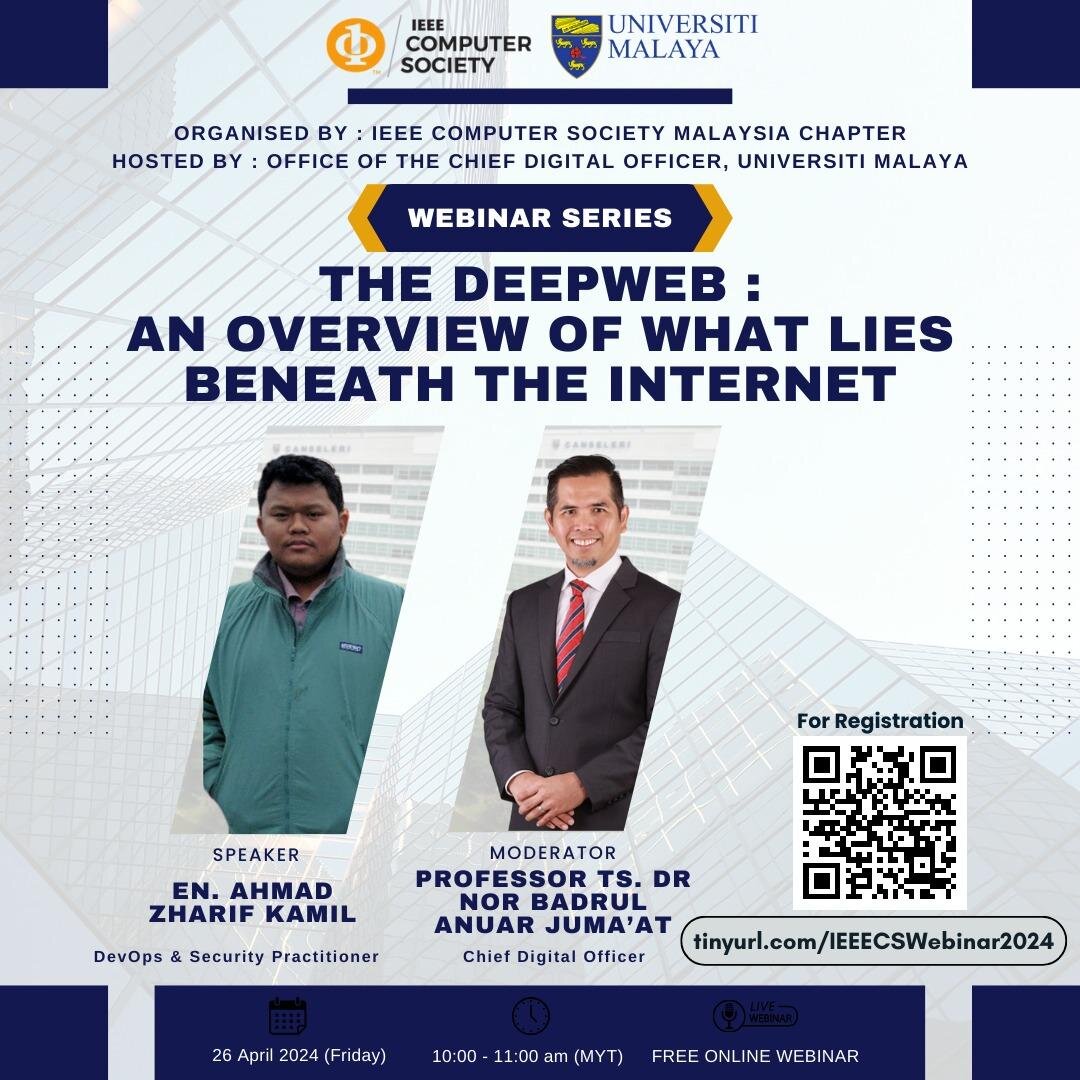
The IEEE Computer Society Malaysia Chapter, with the Office of the Chief Digital Officer, Universiti Malaya, held this session of the 2024 IEEE Computer Society Malaysia Chapter Webinar Series, "Embracing the Future: Cutting-Edge IT Trends and Innovations", attended by 63 participants.
Session Details
- Title: The Deep Web: What Lies Beneath the Internet
- Date: Friday, 26 April 2024
- Time: 10:00 a.m. - 11:00 a.m. (MYT)
- Format: Online webinar via Google Meet
Watch the Recording
The full session, including the Q&A, is available on YouTube: https://youtu.be/vw10cdkmUyU
Synopsis
This webinar explores the deep and dark web: what they are, their legal implications, potential benefits and risks. It covers tools such as Tor, the dark web's link to illegal activity, its potential for stronger privacy and free speech, and the challenges it poses for enforcement agencies.
Speaker
Ahmad Zharif Kamil Zakaria, Technology and DevOps Security Officer
Moderator
Prof. Ts. Dr. Nor Badrul Anuar Bin Juma'at, Chief Digital Officer, Universiti Malaya, and Head of CSNET.
Highlights from the Session
- The deep web is everything search engines cannot index, such as databases, intranets, paywalled journals and online banking, and it makes up around 95% of the internet.
- The dark web is a small subset of the deep web reached through Tor, which bounces traffic through randomly chosen relays that each peel off one layer of encryption, so no single node sees the full path.
- In the demo the speaker browsed onion sites from a disposable Tails virtual machine over a VPN with Tor Browser on its safest setting, and warned never to log into personal accounts such as Facebook there.
- Dark web marketplaces and forums trade drugs, weapons, ransomware as a service, stolen credit cards, database leaks and zero-day exploits, often behind paid or invite-only membership.
- Using the dark web is not illegal in itself, only taking part in illegal activity is, and if your credentials appear in a leak you should change your passwords and enable two-factor authentication.